Street Address
City, State, Zip
Phone Number
Your Custom Text Here
This exhibit is for the person completing a dissertation, thesis, journal article or paper on African Americans with substance use disorders. Gratitude is given to historian William White, MA for his mayor contribution to this exhibit.
Marijuana in African American Communities Annotated Bibliography Completed by: Hendricks, L., Smith, D., Agenor, E., Myneni, J., February 23, 2026 Publication: Museum of African American, Addictions, Treatment and Recovery. March 2026. Volume 3. Edition 4 Introduction This annotated bibliography provides historical and current references on marijuana use in African American communities which scholars, researchers, historians and policy makers can use to inform their work in understanding and addressing marijuana use in African American communities on micro and macro levels.
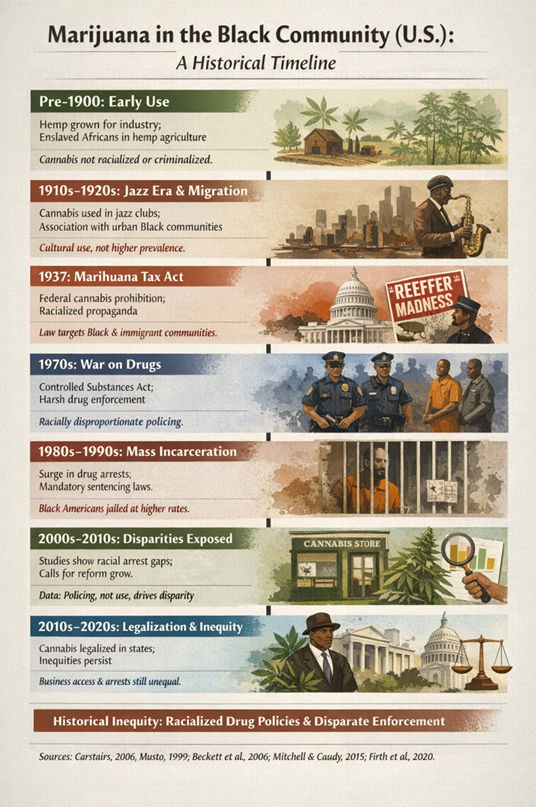
Marijuana in the African American Community
Annotated Bibliography
Foundational History, Culture, and Origins
1. Duvall, C. S. (2019). The African Roots of Marijuana. Duke University Press.
https://doi.org/10.1215/9781478004530
Comprehensive historical account of cannabis in Africa and the African diaspora, essential for
understanding the plant’s cultural origins and early global trajectories.
Criminalization, Policy, and Racialized Enforcement
2. Sheehan, B. E., Grucza, R. A., & Plunk, A. D. (2021). “Association of Racial Disparity of
Cannabis Possession Arrests Among Adults and Youths With Statewide Cannabis Decriminalization and
Legalization.” JAMA Health Forum, 2(10), e213435. https://doi.org/10.1001/jamahealthforum.2021.3435
National evidence showing persistent Black–White disparities in cannabis arrest rates even after
policy reform.
3. Cross, H., & Sutter, J. (2023). “Colors of Cannabis in the U.S.: An Analysis of Race and
Marijuana Legalization.” SACAD: Scholarly Activities, 2023, Article
42. https://doi.org/10.58809/ABNS1917
Empirical analysis correlating state legalization status with racial demographic patterns in
arrests.
4. Jones, K. A., Agboh, D., Patten, M., & Chauhan, P. (2021). “An Examination of Racial
Disparities in Misdemeanor Marijuana Possession Arrests Following Reforms….” Journal of Drug Policy
Analysis, 14(1), 1–
23. https://doi.org/10.1515/jdpa-2021-0008
Multi-jurisdictional evidence of arrest disparities post-reform, highlighting racial enforcement
gaps.
5. Reid, A. E., Crump, M. E. S., & Singh, R. P. (2024). “Improving Black Entrepreneurship through
Cannabis-Related Education.” Education Sciences, 14(2),
135. https://doi.org/10.3390/educsci14020135
Focuses on educational strategies to support Black participation in cannabis industry equity.
6. McCarthy, S. D. S. (2025). “Pipe Dreams: Cannabis Legalization and the Persistence of Racial
Disparities in Jail Incarceration.” Journal of Criminal Justice, 94, 102230.
https://doi.org/10.1016/j.jcrimjus.2024.102230
Shows that legalization did not eliminate racial incarceration disparities, especially for Black
Americans.
7. National Academies of Sciences, Engineering, and Medicine. (2024). “How Cannabis Policy
Influences Social and Health Equity.” Cannabis Policy Impacts Public Health and Health Equity.
Washington, DC: The National Academies
Press. https://doi.org/10.17226/27766
Structural racism framework for understanding why cannabis policy reforms have uneven racial
impacts.
8. Gunadi, C., & Shi, Y. (2022). “Cannabis Decriminalization and Racial Disparity in Arrests…”
Social Science & Medicine, 293,
114672. https://doi.org/10.1016/j.socscimed.2021.114672
Racial arrest data showing decriminalization reduces arrests but disparities persist.
9. Shih, R. A., Tucker, J. S., & Pedersen, E. R. (2021). “Density of Cannabis Outlets and
Racial/Ethnic Differences…” Journal of Cannabis Research, 3,
28. https://doi.org/10.1186/s42238-021-00084-y
Investigates outlet density and racial differences, connecting enforcement to community
environments.
10. Jones, C. R., & Tonry, M. (2008). “Racial Disparities in Criminal Justice: Policies and
Patterns.” Crime and Justice, 37(1), 201–254. https://doi.org/10.1086/522360
Broader criminal justice disparities context in which marijuana enforcement fits.
11. Alexander, M. (2010). The New Jim Crow: Mass Incarceration in the Age of Colorblindness. New
Press.
This is seminal for contextualizing racialized drug policy in the U.S.
12. Beckett, K., & Herbert, S. (2009). “The Consequences and Costs of Marijuana Prohibition.” Law &
Policy, 31(2), 153–183. https://doi.org/10.1111/j.1467-9930.2009.00306.x
Policy analysis demonstrating unintended impacts of prohibition on minority communities.
13. Musto, D. F. (1999). The American Disease: Origins of Narcotics Control. Oxford University
Press.
Classic historical treatment of drug policy origins, essential for early cannabis law context.
14. Pacula, R. L., & Smart, R. (2017). “Medical Marijuana and Policy.” Annual Review of Public
Health, 38, 79–99. https://doi.org/10.1146/annurev-publhealth-031816-044527
Explains policy trends including racial justice motivations behind reform.
15. Pacula, R. L., et al. (2015). “Assessing the Effects of Medical Marijuana Laws on Marijuana
Use…” RAND Health Quarterly, 5(2), 12.
Policy evaluation relevant to racial dynamics.
Empirical Use Patterns & Health Outcomes
16. Assari, S., Mistry, R., & Caldwell, C. H. (2018). “Marijuana Use and Depressive Symptoms…”
Frontiers in Psychology, 9,
2135. https://doi.org/10.3389/fpsyg.2018.02135
Analyzes marijuana use, race, and mental health among African American adolescents.
17. Dogan, J. N., et al. (2021). “Cultural Race-Related Stress and Cannabis Use…” Psychology of
Addictive Behaviors, 35(3), 320–
325. https://doi.org/10.1037/adb0000694
Links race-related stress with cannabis use among incarcerated African American men.
18. Hasin, D. S., et al. (2015). “Prevalence of Marijuana Use Disorders in the U.S.” JAMA
Psychiatry, 72(12), 1235–1242. https://doi.org/10.1001/jamapsychiatry.2015.1858
Foundational epidemiological data on use disorders relevant to racial comparisons.
19. Keyes, K. M., et al. (2016). “Evidence for U.S. Cannabis Use Trends by Race/Ethnicity…”
International Journal of Drug Policy, 36, 100–
107. https://doi.org/10.1016/j.drugpo.2016.06.009
Describes trends among different racial groups over time.
20. Substance Abuse and Mental Health Services Administration. (2020). National Survey on Drug Use
and Health: Racial/Ethnic Disparities.
Economic, Industry, and Social Equity
21. Doonan, S. M., Johnson, J. K., Firth, C., et al. (2022). “Racial Equity in Cannabis Policy…”
Cannabis, 5(1), 30–41. https://doi.org/10.26828/cannabis/2022.01.004
Shows limited diversity in senior roles in cannabis industry despite policy intentions.
22. Rolles, S., et al. (2020). “Economic Outcomes of Cannabis Legalization for Minority
Communities.” Journal of Drug Issues, 50(3), 353–
369. https://doi.org/10.1177/0022042620904298
23. Light, M. K., et al. (2020). “Market Concentration and License Equity in U.S. Cannabis.”
Journal of Cannabis Research, 2, 4. https://doi.org/10.1186/s42238-020-00019-x
24. Smart, R., & Pacula, R. L. (2019). “Early Evidence of the Impacts of Cannabis Legalization…”
Addiction, 114(5), 769–774. https://doi.org/10.1111/add.14610
25. Kilmer, B. (2019). “Policy Designs for Cannabis Legalization: Starting with the Pot of Gold.”
International Journal of Drug Policy, 66, 1–
2. https://doi.org/10.1016/j.drugpo.2019.02.004
Criminal Justice, Policing, and Enforcement Mechanisms
26. Gorodnichenko, Y., et al. (2021). “Policing, Race, and Marijuana
Enforcement.” American Economic Journal: Economic Policy, 13(4), 141–
171. https://doi.org/10.1257/pol.20190641
27. Ridgeway, G., & MacDonald, J. (2019). “Contact and Consequences: A New Look at Racial
Disparities in Police Stops.” Journal of the American Statistical Association, 114(525), 1172–
1184. https://doi.org/10.1080/01621459.2018.1497776
28. Warren, P. Y., & Hollinger, R. C. (2025). “Race, Drugs, and Punishment: Cannabis Case Outcomes
in U.S. Courts.” Justice Quarterly (in press).
29. National Institute of Justice. (2022). “Racial Disparities in the Wake of Cannabis
Legalization.” NIJ Report 307696.
30. United States Sentencing Commission. (2017). Special Report: The Past Decade of Marijuana
Cases.
Social Determinants, Health Equity, and Public Health Impact
31. Pacula, R. L., et al. (2014). “Assessing the Public Health Impacts of Legalization.” Annual
Review of Public Health, 35, 203–
219. https://doi.org/10.1146/annurev-publhealth-032013-182431
32. Schuermeyer, J., et al. (2014). “Trends in Cannabis Use Disorders by Race/Ethnicity…” Drug and
Alcohol Dependence, 134, 155–
164. https://doi.org/10.1016/j.drugalcdep.2013.10.024
33. Hasin, D. S. (2018). “US Epidemiology of Cannabis Use and Associated Problems.”
Neuropsychopharmacology, 43(10), 195–
212. https://doi.org/10.1038/npp.2017.198
34. Mason, M. J., et al. (2016). “Neighborhood Risk, Cannabis Use, and African American
Youth.” Journal of Adolescent Health, 58(5), 549–5
555. https://doi.org/10.1016/j.jadohealth.2015.12.016
35. Hayes, M. J., & Brown, L. J. (2023). “Cannabis Legalization and Public Health Equity.” Public
Health Reviews, 44,
1604785. https://doi.org/10.3389/phrs.2023.1604785
Policy Evaluation, Reform, and Equity Programs
36. Mikos, R. A. (2019). “Lessons from Marijuana Legalization in Colorado and Washington.”
University of Pennsylvania Journal of Constitutional Law, 21, 1211–1254.
37. Kilmer, B., & Pacula, R. L. (2018). “Understanding and Learning from Cannabis Legalization
Countries.” Annual Review of Law and Social Science, 14, 201–
219. https://doi.org/10.1146/annurev-lawsocsci-110615-085428
38. Smart, R., et al. (2021). “Policy Design Patterns and Racial Equity Outcomes in Cannabis
Legalization.” International Journal of Drug Policy, 94,
103208. https://doi.org/10.1016/j.drugpo.2021.103208
39. Collective Impact Evaluation of Equity Programs in Legal Cannabis. (2025). Journal of Public
Policy & Marketing.
40. Legal Scholars’ Roundtable on Social Equity Licensing. (2023). Regulation & Governance.
Community, Identity, and Narrative Perspectives
41. Mason, W. A., et al. (2020). “Cultural Dimensions of Cannabis Use Among African American
Adults.” Journal of Ethnicity in Substance Abuse, 19(3), 321–
339. https://doi.org/10.1080/15332640.2020.1710470
42. Jones, C. M., et al. (2018). “Self-Reported Reasons for Cannabis Use Across Races.” Addictive
Behaviors, 76, 32–
39. https://doi.org/10.1016/j.addbeh.2017.08.011
43. Taylor, R. J., et al. (2017). “Racial Differences in Drug Policy Perceptions.” Drug and Alcohol
Dependence, 173, 65–
73. https://doi.org/10.1016/j.drugalcdep.2016.12.021
44. Craig, R. J., & Peck, J. (2019). “Media Framing of Marijuana and Race.” Communication Research
Reports, 36(2), 104–
113. https://doi.org/10.1080/08824096.2019.1585382
45. Henne, K., & Troshynski, E. (2021). “Cannabis and Identity Politics.” Social Science Quarterly,
102(4), 1392–1407. https://doi.org/10.1111/ssqu.13000
Comparative and Related Studies
46. Keyes, K. M., Schulenberg, J. E., & O’Malley, P. M. (2020). “Race/Ethnicity and Marijuana Use
Trends…” Drug and Alcohol Dependence, 209,
107901. https://doi.org/10.1016/j.drugalcdep.2020.107901
47. Wallace, J. M., Jr., & Bachman, J. G. (1991). “Explaining Racial/ethnic Differences in
Adolescent Drug Use.” American Journal of Public Health, 81(3), 304–
309. https://doi.org/10.2105/AJPH.81.3.304
48. Johnson, R. (2022). “Marijuana Legalization in Comparative Perspective.” International Journal
of Drug Policy, 102,
103624. https://doi.org/10.1016/j.drugpo.2022.103624
49. Hughes, C. E., & Stevens, A. (2010). “What Can We Learn from the Portuguese Decriminalization
of Illicit Drugs?” British Journal of Criminology, 50(6), 999–1022.
https://doi.org/10.1093/bjc/azq038
50. National Institute on Drug Abuse. (2024). Racial and Ethnic Disparities in Drug Use and its
Consequences.
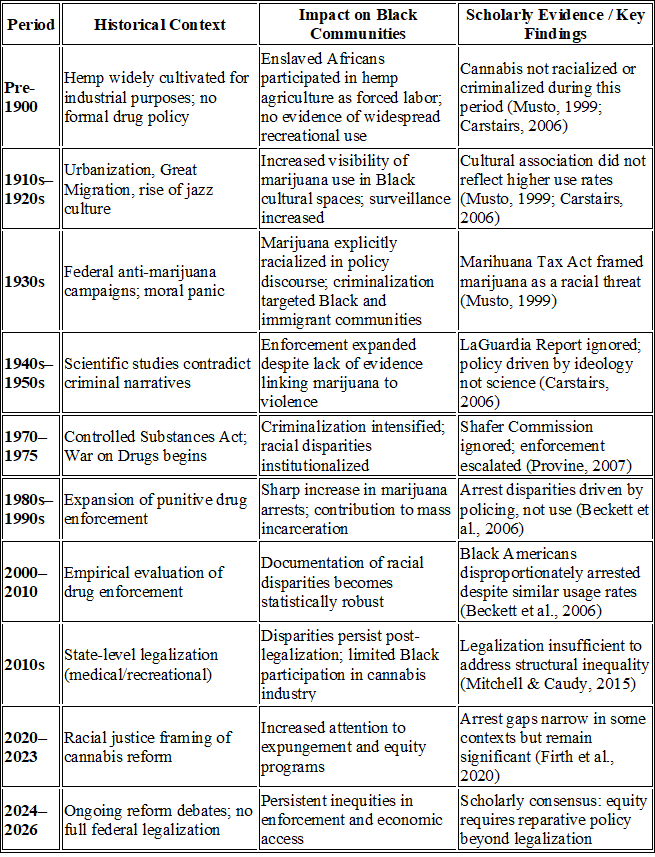
Marijuana in the Black Community (U.S.): Evidence-Based Timeline Table
Alexander, M. (2010). The new Jim Crow: Mass incarceration in the age of colorblindness.
DOI: 10.1007/s12111-009-9103-4
Beckett, K., Nyrop, K., & Pfingst, L. (2006). Race, drugs, and policing. Criminology, 44(1),
105–137. DOI: 10.1111/j.1745-9125.2006.00044.x
Carstairs, C. (2006). Marijuana, race, and drug policy construction. Journal of Social History,
40(1), 137–160. DOI: 10.1353/jsh.2006.0159
Firth, C. L., et al. (2020). Marijuana legalization and racial disparities. Substance Use & Misuse,
55(10), 1582–1587. DOI: 10.1080/10826084.2020.1765803
Mitchell, O., & Caudy, M. S. (2015). Racial disparities in drug arrests. Justice Quarterly, 32(2),
288–313. DOI: 10.1080/07418825.2012.761721
Musto, D. F. (1999). The American disease: Origins of narcotic control.
DOI: 10.1093/acprof:oso/9780195125092.001.0001
Provine, D. M. (2007). Unequal under law.
DOI: 10.2139/ssrn.1029278 _______________________________________________________________________________________
Bibliography of Addiction Recovery Within African American Communities Collated by Mark Sanders and William White
Historical Perspectives
Cheagle, R. (1969). The colored temperance movement (Unpublished thesis). Washington, DC: Howard University, 1969.
Christmon, K. (1995). Historical overview of alcohol in the African American community. Journal of Black Studies, 25(3), 318-330.
Courtwright, D. (1983). The hidden epidemic: Opiate addiction and cocaine use in the south, 1860-1920. Journal of Southern History, 49, 57-72.
Crowley, J. (1997). Slaves to the bottle: Gough’s autobiography and Douglass’s narrative. In Reynolds, D. and Rosenthal, D. (Eds.). The serpent in the cup: Temperance in American literature. Amerherst, MA: University of MA Press.
Glen C. (2017). Heroes of early black AA. South Bend, IN: Hindsfoot Foundation.
Green, W. (1995). Dysfunctional by design: The rebirth of cultural survivors. Evanston, IL: Chicago Spectrum Press.
Herd, D. (1985). We cannot stagger to freedom: A history of Blacks and alcohol in American politics. In L. Brill and C. Winick, The yearbook of substance use and abuse: Volume III. New York, NY: Human Sciences Press, Inc.
Katz, W. (1990). Breaking the chains: African-American slave resistance. New York, NY: Maxwell Macmillan International Publishing Group.
Larkins, J.R. (1965). Alcohol and the Negro: Explosive issues. Zebulon, NC: Recod Publishing.
Pan, L. (1975). Alcohol in colonial Africa. New Brunswick, NJ: Helsinki: The Finnish Foundation for Alcohol Studies.
Sanders, M. (2002). The response of African American communities to addiction: An opportunity for treatment providers. Alcoholism Treatment Quarterly, 3-4, 167-174.
White, W. & Sanders, M. (2002) Addiction and recovery among African Americans before 1900. Counselor, 3(6):64-66.
Williams, C. with Laird, R. (1992). No hiding place: Empowerment and recovery for troubled communities. New York, NY: Harper San Francisco.
Williams, E.H. (1914). The Drug habit in the south. Medical Record, 85, 247-249.
DRUGS AND MINORITY OPPRESSION
Recovery Autobiographies and Biographies
Douglass, F. (1855). My bondage and my freedom. New York, NY: Miller, Orton, & Mulligan.
Key Scientific Studies and Professional Papers
Acevedo, A., Garnick, D.W., Lee, M.T., Horgan, M., Ritter, G., Ph, D., Panas, L., Davis, S., Leeper, T., Moore, R., Reynolds, M. (2013). Racial/ethnic differences in substance abuse treatment initiation and engagement. J. Ethn. Subst. Abuse, 11, 1–17. https:// doi.org/10.1080/15332640.2012.652516.Racial/Ethnic.
Achara-Abrahams, I., Evans, A. C., Ortiz, J., Lopez Villegaz, D., O’Dell, J., Ali, O., & Hawkins, D. (2012). Recovery Management and African Americans: A Report from the Field. (Special Issue: Patterns of Recovery from Substance Use Disorders in African American Communities). Alcoholism Treatment Quarterly, 30(3), 263-292.
Alegria, M., Carson, N. J., Goncalves, M., et al. (2011). Disparities in treatment for substance use disorders and co-occurring disorders for ethnic/racial minority youth. J Am Acad Child Adolesc Psychiatry, 50(1), 22-31. https://doi.org/10.1016/j.jaac.2010.10.005.
Alexander, K., Reed, M. K., & Sterling, R. C. (2023). The interaction of race and age in methadone treatment retention outcomes: A single-center analysis. J Subst Use Addict Treat, 148, 209020.
Alexander, M. J., Kiang, M. V. & Barbieri, M. (2018). Trends in Black and White opioid mortality in the United States, 1979–2015. Epidemiology, 29(5), 707-715.
Andraka-Christou, B., Totaram, R., & Nguyen, T. D. (2022). Comprehensive analysis of discharge reasons from methadone outpatient treatment programs. Am J Addict, 31(6), 508-516.
Arndt, S., Vélez, M. B., Segre, L., & Clayton, R. (2010). Remission from substance dependence in U.S. Whites, African Americans, and Latinos. Journal of Ethnicity in Substance Abuse, 9(4), 237-248.
Avalos, L. A. & Mulia, N. (2012). Formal and informal substance use treatment utilization and alcohol abstinence over seven years: Is the relationship different for Blacks and Whites? Drug Alcohol Depend., 121(0), 73–80. doi:10.1016/j.drugalcdep.2011.08.018.a
Avila, J. C., Sokolovsky, A, W,, Nollen, N. L., Lee, J., Schmid, C. H., & Ahluwalia, J. S. (2022). The effect of race/ethnicity and adversities on smoking cessation among U.S. adult smokers. Addict Behav, 131, 107332.
Barthwell, A.G. & Crants, M. (2017). Women of color in Alcoholics Anonymous. Counselor, 18(4), 43-48.
Blakey, J. M. (2012). From surviving to thriving: Understanding reunification among African American mothers with histories of addiction. Children and Youth Services Review, 34(1), 91-102. doi: 10.1016/j.childyouth.2011.09.006
Bluthenthal, R. N., Jacobson, J, & Robinson, P. L. (2007). Are racial disparities in alcohol treatment completion associated with racial differences in treatment modality entry? Comparison of outpatient treatment and residential treatment in Los Angeles County, 1998 to 2000. Alcoholism Clinical and Experimental Research, 31(11), 1920-6 Follow journal DOI: 10.1111/j.1530-0277.2007.00515.x
Bommersbach, T. J., Jegede, O., Stefanovics, E. A., Rhee, T, G., & Rosenheck, R. A. (2022). Diagnostic remission of substance use disorders: Racial differences and correlates of remission in a national sample. Journal of Substance Abuse Treatment, 136, 108659.
Bourgois, P., Martinez, A., Kral, A., Edlin, B. R., Schonberg, J., & Ciccarone, D. (2006). Reinterpreting ethnic patterns among white and African American men who inject heroin: A social science of medicine approach. PLoS Medicine, 3(10), e452. https://doi.org/ 10.1371/journal.pmed.0030452
Bowser, B. P., & Bilal, R. (2001). Drug treatment effectiveness: African-American culture in recovery. Journal of Psychoactive Drugs, 33(4), 391-402.
Brown, E. J., & Trujillo, T. H. (2003). “Bottoming out?” among rural African American women who use cocaine. The Journal of Rural Health, 19(4), 441-449.
Brown, J. T., Davis, M. I., Jason, L. A., & Ferrari, J. R. (2006). Stress and coping: The roles of ethnicity and gender in substance abuse recovery. Journal of Prevention & Intervention Community, 31(1-2), 75–84. https://doi.org/10.1300/j005v31n01_07
Buka, S. L. (2002). Disparities in health status and substance use: Ethnicity and socioeconomic factors. Public Health Reports, 117 (Suppl. 1), S118-S125.
Burlew, A. K., & Sanchez, K. (2017). Personal and contextual factors in substance abuse treatment among racial and ethnic minorities: Studies from the NIDA clinical trials network. Journal of Ethnicity in Substance Abuse, 16(4), 401–403. https://doi.org/10.1080/ 15332640.2017.1409951
Caetano, R. (1993). Ethnic minority groups and Alcoholics Anonymous: A review. In B. McCrady, & W. Miller (Eds.), Research on Alcoholics Anonymous: Opportunities and alternatives (pp. 209-231). New Brunswick, NJ: Rutgers Center of Alcohol Studies.
Caldwell, F. J. (1983). Alcoholics Anonymous as a viable treatment resource for black alcoholics. In T. D. Watts, & R. Wright (Eds.), Black Alcoholism: Toward a Comprehensive Understanding (pp. 85-99). Springfield, IL: Charles C. Thomas.
Chartier, K. G., & Caetano, R. (2011). Trends in alcohol services utilization from 1991–1992 to 2001–2002: Ethnic group differences in the US population. Alcoholism: Clinical and Experimental Research, 35(8), 1485–1497.
Chartier, K., Hesselbrock, M. N., & Hesselbrock, V. M. (2013). Ethnicity and gender comparisons of health consequences in adults with alcohol dependence. Substance Use & Misuse, 8(3), 200-10. doi: 10.3109/10826084.2013.74774.
Chartier, K. G., Vaeth, P. A. C., Caetano, R. (2013). Focus on: Ethnicity and the social and health harms from drinking. Alcohol Res., 35(2):229-237.
Chen, J. A., Glass, J. E., Bensley, K. M., Goldberg, S. B., Lehavot, K., & Williams, E. C. (2020). Racial/ethnic and gender differences in receipt of brief intervention among patients with unhealthy alcohol use in the US Veterans Health Administration. Journal of Substance Abuse Treatment, 108078.
Cheney, A. M., Booth, B. M., Borders, T. F., & Curran, G. M. (2016). The role of social capital in African Americans’ attempts to reduce and quit cocaine use. Substance Use & Misuse, 51(6), 777–787. https://doi.org/10.3109/10826084.2016.1155606
Cheney, A. M., Curran, G. M., Booth, B. M., Sullivan, S., Stewart, K., & Borders, T. F. (2014). The religious and spiritual dimensions of cutting down and stopping cocaine use: A qualitative exploration among African American women in the South. Journal of Drug Issues, 44(1), 94-113.
Collins-Henderson, M. (2012). Identity development's impact on peer-supported recovery among African American women. Alcoholism Treatment Quarterly, 30(3), 307. doi: 10.1080/07347324.2012.690698
Cook, B. L., Alegría, M. (2011). Racial-ethnic disparities in substance abuse treatment: the role of criminal history and socioeconomic status. Psychiatr Serv., 62(11), 1273–81.
Cummings, J. R., Wen, H., Druss, B. G. (2011). Racial/ethnic differences in treatment for substance use disorders among U.S. adolescents. J Am Acad Child Adolesc Psychiatry., 50(12), 1265-1274. https://doi.org/10.1016/j.jaac.2011.09.006.
Cummings, J.R., Wen, H., Ko, M., Druss, B.G., 2014. Race/ethnicity and geographic access to medicaid substance use disorder treatment facilities in the United States. JAMA Psychiatry, 71, 190–196. https://doi.org/10.1001/jamapsychiatry.2013.3575.
De Kock, C., & Decorte, T. (2017). Exploring problem use, discrimination, ethnic identity and social networks. Drugs and Alcohol Today, 17(4), 269–279. https://doi.org/10.1108/ DAT-07-2017-0030
Dogana, J., Stevens-Watkins, D., Knighton, J-S., Wheeler, P. & Hargons, C. (2021). Perceived need for drug treatment among African American male drug-using prisoners. Journal of Substance Abuse Treatment, 120, 108166.
Durant, A. (2005). African-American alcoholics: An interpretive/ constructivist model of affiliation with alcoholics (AA). J Ethn Subst Abuse., 4(1), 5-21. https://doi.org/10.1300/ j233v04n01_02.
Ehrmin, J. T. (2002). “That feeling of not feeling”: Numbing the pain for substance-dependent African American women. Qualitative Health Research, 12(6), 780–791. https://doi. org/10.1177/104973230201200605
Entress, R. M. (2021). The intersection of race and opioid use disorder treatment: A quantitative review. Journal of Substance Abuse Treatment, 131, 108589.
Evans, A. C., Achara-Abrahams, I., Lamb, R., & White, W. (2012). Ethnic-Specific support systems as a method for sustaining long-term addiction recovery. Journal of Groups in Addiction & Recovery, 7(2-4), 171-188.
Evans, E.A., Grella, C.E., Washington, D.L., Upchurch, D.M., 2017. Gender and race/ ethnic differences in the persistence of alcohol, drug, and poly-substance use disorders. Drug Alcohol Depend., 174, 128–136. https://doi.org/10.1016/j.drugalcdep. 2017.01.021.
Flückiger, C., Del Re, A.C., Horvath, A.O., Symonds, D., Ackert, M., Wampold, B.E., 2013. Substance use disorders and racial/ethnic minorities matter: a meta-analytic examination of the relation between alliance and outcome. J. Couns. Psychol., 60, 610–616. https://doi.org/10.1037/a0033161.
Gallagher, J. R. (2013). African American participants’ views on racial disparities in drug court outcomes. Journal of Social Work Practice in the Addictions, 13, 143-162.
Gallagher, J. R. & Norberg, A. (2016). Comparing and contrasting White and African American participants’ lived experiences in drug court. Journal of Ethnicity in Criminal Justice, 14, 100-119.
Gallagher, J. R. & Wahler, E. A. (2018). Racial disparities in drug court graduation rates: The role of recovery support groups and environments. Journal of Social Work Practice in the Addictions, 18, 1-15.
Gao, Y. A., Drake, C., Krans, E. E., Chen, Q., & Jarlenski, M. P. (2022). Explaining racial-ethnic disparities in the receipt of medication for opioid use disorder during pregnancy. J Addict Med, 16(6), e356-e365
Gerrard, M., Stock, M. L., Roberts, M. E., Gibbons, F. X., O'Hara, R. E., Weng, C. Y., & Wills, T. A. (2012). Coping with racial discrimination: The role of substance use. Psychology of Addictive Behaviors, 26(3), 550–560. https://doi.org/10.1037/ a0027711
Gibbons, F. X., Etcheverry, P. E., Stock, M. L., Gerrard, M., Weng, C. Y., Kiviniemi, M., & O'Hara, R. E. (2010). Exploring the link between racial discrimination and substance use: What mediates? What buffers? Journal of Personality and Social Psychology, 99 (5), 785–801. https://doi.org/10.1037/a0019880
Gilder, D. A., Lau, P., Corey, L., & Elders, C. L. (2008). Factors associated with remission from alcohol dependence in an American Indian community group. American Journal of Psychiatry, 165(9), 1172-1178.
Goedel, W. C., Shapiro, A., Cerda, ´ M., Tsai, J. W., Hadland, S. E., & Marshall, B. D. L. (2020). Association of racial/ethnic segregation with treatment capacity for opioid use disorder in counties in the United States. JAMA Network Open, 3(4), e203711. https://doi.org/10.1001/jamanetworkopen.2020.3711.
Goodyear, K., Ahluwalia, J., & Chavanne, D. (2022). The impact of race, gender, and heroin use on opioid addiction stigma. J Subst Abuse Treat, 143, 108872.
Grant, J. D., Vergés, A., Jackson, K. M., Trull, T. J., Sher, K. J., Bucholz, K. K. (2012). Age and ethnic differences in the onset, persistence and recurrence of alcohol use disorder. Addiction, 107, 756–65.
Guerrero, E.G., Garner, B.R., Cook, B., Kong, Y., (2017). Does the implementation of evidence-based and culturally competent practices reduce disparities in addiction treatment outcomes? Addict. Behav., 73, 119–123. https://doi.org/10.1016/j.addbeh.2017.05.006.
Guerrero, E. G., Khachikian, T., Frimpong, J. A., [...] & Hunter, S. (2019). Drivers of continued implementation of cultural competence in substance use disorder treatment. Journal of Substance Abuse Treatment, 105, 5-11.
Guerrero, E. G., Marsh, J. C., Duan, L.[...] & Lee, B. (2013). Disparities in completion of substance abuse treatment between and within racial and ethnic groups. Health Services Research, 48(4), 1450-67. doi: 10.1111/1475-6773.12031
Hai, A. H., Lee, C. S., Abbas, B. T., Bo, A., Morgan, H., & Delva, J. (2021). Culturally adapted evidence-based treatments for adults with substance use problems: A systematic review and meta-analysis. Drug and Alcohol Dependence, 226. https://doi. org/10.1016/j.drugalcdep.2021.108856
Hansen, H.B., Siegel, C.E., Case, B.G., Bertollo, D.N., DiRocco, D., Galanter, M., (2013). Variation in use of buprenorphine and methadone treatment by racial, ethnic, and income characteristics of residential social areas in New York City. J. Behav. Health Serv. Res., 40, 367–377. https://doi.org/10.1007/s11414-013-9341-3.
Hillhouse, M., Fiorentine, R. (2001). 12-step program participation and effectiveness: Do gender and ethnic differences exist? Journal of. Drug Issues, 31 (3), 767–780.
Holland, W. C., Li, F., Nath, B., Jeffery, M. M., Stevens, M., Melnick, E. R., Dziura, J. D., Khidir, H., Skains, R. M., D'Onofrio, G., & Soares, W. E. (2023). Racial and ethnic disparities in emergency department-initiated buprenorphine across five health care systems. Acad Emerg Med, 2023.
Hollander, M. A. G., Chang, C-C, Douaihy, A. B., Hulsey, E., & Donahue, J. M. (2021). Racial inequality in medication treatment for opioid use disorder: Exploring potential facilitators and barreris to use. Drug and Alcohol Dependence, 227, 108927.
Hudson, H. L. (1985). How and why Alcoholics Anonymous works for Blacks. Alcoholism Treatment Quarterly, 2(3-4), 11-30.
Humphreys, K., Mavis, B. E., & Stoffelmayr, B. E. (1994). Are twelve-step programs appropriate for disenfranchised groups? Evidence from a study of posttreatment mutual help involvement. Prevention in Human Services, 11(1), 165-179. doi: 10.1080/10852359409511201
Humphreys, K., & Woods, M. (1993). Researching mutual help group participation in a segregated society. Journal of Applied Behavioral Science, 29(2), 181-201.
Husain, J. M., Cromartie, D., Fitzelle-Jones, E., Brochier, A., Borba, C. P. C., & Montalvo, C. (2023). A qualitative analysis of barriers to opioid agonist treatment for racial/ethnic minoritized populations. J Subst Abuse Treat, 144, 108918.
Jacobson, J., Robinson, P. L., & Bluthenthal, R. (2007). Racial disparities in completion rates from publicly funded alcohol treatment: Economic resources explain more than demographics and addiction severity. Health Services Research, 42(2), 773-94. DOI: 10.1111/j.1475-6773.2006.00612.x
Jacobson, N., & Farah, D. (2012). Recovery through the lens of cultural diversity. Psychiatric Rehabilitation Journal, 35(4), 333–335. doi:10.2975/35.4.2012.333.335
James, K. & Jordan, A. (2018). The opioid crisis in Black communities. Journal of Law, Medicine, & Ethics, 46, 404-421.
Jones, A. A., Schneider, K. E., Tobin, K. E., O'Sullivan, D. & Latkin, C. A. (2023). Daily opioid and stimulant co-use and nonfatal overdoses in the context of social disadvantage: Findings on marginalized populations. J Subst Use Addict Treat, 208986.
Jones, L., Hardiman, E. and Carpenter, J. (2007) ‘Mental health recovery: A strengths-based approach to culturally relevant services for African Americans’, Journal of Human Behaviour in the Social Environment, 15(2), 251–69.
Karriker-Jaffe, K. J., Zemore, S. E., Mulia, N., Jones-Webb, R., Bond, J., & Greenfield, T. K. (2012). Neighborhood disadvantage and adult alcohol outcomes: Differential risk by race and gender. Journal of Studies on Alcohol and Drugs, 73(6), 865-873.
Kaskutas, L. A., Weisner, C., Lee, M., et al. (1999). Alcoholics Anonymous affiliation at treatment intake among white and black Americans. J Stud Alcohol, 60(6), 810-816.
Kitsantas, P., Aljoudi, S. M., Baker, K. M., Peppard, L., Oh, K. M. (2023). Racial/ethnic differences in medication for addiction treatment for opioid use disorders among pregnant women in treatment facilities supported by state funds. J Subst Use Addict Treat, 148, 208960.
Klein, H., Sterk, C., & Elifson, K. (2016). The prevalence of and factors associated with alcohol-related problems in a community sample of African American women. Journal of Addiction, 2016, 1–11. https://doi.org/10.1155/2016/7513827
Krentzman, A. R., Pagano, M. E., Bradley, J. C., et al. (2012). The role of religiousness on substance-use disorder treatment outcomes: A comparison of Black and White adolescents. J Soc Social Work Res., 3(3), 113-128. https://doi.org/10.5243/jsswr.2012.8.
Lagisetty, P. A., Ross, R., Bohnert, A., Clay, M., & Maust, D. T. (2019). Buprenorphine treatment divide by race/ethnicity and payment. JAMA Psychiatry, (ePub ahead of print). doi: 10.1001/jamapsychiatry.2019.0876
Lo, C. C., & Cheng, T. C. (2011). Racial/ethnic differences in access to substance abuse treatment. Journal of Health Care for the Poor and Underserved, 22(2), 621–637. https://doi.org/10.1353/ hpu.2011.0054
Lowman, C., & Fauve, C. (2003). Health disparities and the relationship between race, ethnicity, and substance abuse treatment outcomes. Alcoholism, Clinical and Experimental Research, 27(8), 1324–1326. https://doi.org/10.1097/01.ALC.0000080346.62012.DC
Marlowe. D. B. (2013). Achieving racial and ethnic fairness in drug courts. Court Review, 49, 40-47.
Martin, C. E., Britton, E., Shadowen, H., Bachireddy, C., Harrell, A., Zhao, X., & Cunningham, P. (2023). Disparities in opioid use disorder-related hospital use among postpartum Virginia Medicaid members. J Subst Use Addict Treat, 145, 208935.
Matsuzaka, S., & Knapp, M. (2020). Anti-racism and substance use treatment: addiction does not discriminate, but do we? Journal of Ethnicity in Substance Abuse, 19(4), 567–593.
McCorkel, J. (2013). Breaking women: Gender, race, and the new politics of imprisonment. New York: NYU Press. Retrieved from http://www.jstor.org/stable/j.ctt9qfdw9
McCorkel, J. (2017). The second coming: Gender, race, and the privatization of carceral drug treatment. Contemporary Drug Problems, 44, 286–300.
McKean, J. & Warren-Gordon, K. (2011). Racial differences in graduation rates from adult drug treatment courts. Journal of Ethnicity in Criminal Justice, 9, 41-55.
McKim, A. (2017). Addicted to rehab: Race, gender, and drugs in the era of mass incarceration. New Brunswick, NJ: Rutgers University Press.
Mennis, J., Stahler, G.J., 2016. Racial and ethnic disparities in outpatient substance use disorder treatment episode completion for different substances. J. Subst. Abuse Treat., 63, 25–33. https://doi.org/10.1016/j.jsat.2015.12.007.
Mennis, J., Stahler, G.J., El Magd, S.A., Baron, D.A., (2019). How long does it take to complete outpatient substance use disorder treatment? Disparities among Blacks, Hispanics, and Whites in the US. Addictive Behaviors,, 93, 158–165. https://doi.org/10.1016/j.addbeh.2019.01.041.
Milligan, C. O., Nich, C., & Carroll, K. M. (2004). Ethnic differences in substance abuse treatment retention, compliance, and outcome from two clinical trials. Psychiatric Services, 55(2), 167–173.
Monico, L. B., Gryczynski, J., Schwartz, R. P. Jaffe, J. H., O’Grady, K. E. & Mitchell, S. G., (2018) Treatment outcomes among a cohort of African American buprenorphine patients: Follow-up at 12 months, The American Journal of Drug and Alcohol Abuse, 44, 6, 604-610, DOI: 10.1080/00952990.2018.1461877
Mukku, V. K., Benson, T. G., Alam, F., Richie, W. D., & Bailey, R. K. (2012). Overview of substance use disorders and incarceration of African American males. Frontiers in Psychiatry, 3, 98.
Mulia, N., Ye, Y., Greenfield, T. K., & Zemore, S. E. (2009). Disparities in alcohol-related problems among white, black, and Hispanic Americans. Alcoholism, Clinical and Experimental Research, 33(4), 654–662.
Mulia, N., Tam, T. W., Schmidt, L. A. (2014). Disparities in the use and quality of alcohol treatment services and some proposed solutions to narrow the gap. Psychiatr Serv., 65(5), 626-633. https://doi. org/10.1176/appi.ps.201300188.
Mulia, N., Zemore, S. E. (2012). Social adversity, stress, and alcohol problems: Are racial/ethnic minorities and the poor more vulnerable? J Stud Alcohol Drugs, 73(4), 570-580.
Netherland, J., & Hansen, H. (2016b). The war on drugs that wasn’t: Wasted whiteness, “dirty doctors,” and race in media coverage of prescription opioid misuse. Culture, Medicine and Psychiatry, 40, 664.
Netherland, J. & Hansen, H. B. (2017). White opioids: Pharmaceutical race and the war on drugs that wasn’t. BioSocieties, 12(2), 217-238.
Nguyen, T., Ziedan, E., Simon, K., Miles, J., Crystal, S., Samples, H., & Gupta, S. (2022). Racial and ethnic disparities in buprenorphine and extended-release naltrexone filled prescriptions during the COVID-19 pandemic. JAMA Netw Open, 5(6), e2214765.
Niv, N., Pham, R., & Hser, Y. I. (2009). Racial and ethnic differences in substance abuse service needs, utilization, and outcomes in California. Psychiatric Services, 60(10), 1350–1356. https://doi.org/10.1176/ps.2009.60.10.1350.
Nyamathi, A. M., (1991). Relationship of resources to emotional distress, somatic complaints, and high-risk behaviors in drug recovery and homeless minority women. Research in Nursing & Health, 14(4), 269–277.
Parthasarathy, S., Chi, F. W., Metz, V., Kline-Simon, A., Asyyed, A., Campbell, C. I., & Sterling, S. (2023) Disparities in the receipt of alcohol brief intervention: The intersectionality of sex, age, and race/ethnicity. Addiction.
Peavy, K.M., Garrett, S., Doyle, S., Donovan, D., 2017. A comparison of African American and Caucasian stimulant users in 12-step facilitation treatment. J. Ethn. Subst. Abuse, 16, 380–399. https://doi.org/10.1080/15332640.2016.1185657.
Perron, B., Mowbray, O., Glass, J. E., … & Howard, M. O. (2009). Differences in service utilization and barriers among Blacks, Hispanics, and Whites with drug use disorders. Substance Abuse Treatment Prevention and Policy,4(1), 3. DOI: 10.1186/1747-597X-4-3
Pinedo, M. & Villatoro, A. P. (2020). The role of perceived treatment need in explaining racial/ethnic disparities in the use of substance abuse treatment services. Journal of Substance Abuse Treatment, 118, 108105.
Pinedo, M., Zemore, S. E., Beltran Giron, J. [...] & Castro, Y. (2020). Women’s barriers to specialty substance abuse treatment: A qualitative exploration of racial/ethnic differences. Journal of Immigrant and Minority Health, 22(4), 653-660.
Pinedo, M., Zemore, S., & Mulia, N. (2020). Black-White differences in barriers to specialty alcohol and drug treatment: Findings from a qualitative study. Journal of Ethnicity in Substance Abuse, 1–15.
Pouille, A., De Kock, C., Vander Laenen, F. & Vanderplasschen, W. (2020). Recovery capital among migrants and ethnic minorities: A qualitative systematic review of first-person perspectives. Journal of Ethnicity in Substance Abuse, 2, 1-31. doi: 10.1080/15332640.2020.1836698.
Pro, G., Utter, J., Cram, J., Baldwin, J., 2020. Racial/Ethnic and gender differences in associations of medication-assisted therapy and reduced opioid use between outpatient treatment admission and discharge. J. Psychoactive Drugs, 0, 1–9. https://doi. org/10.1080/02791072.2020.1717685.
Reid, Campbell Aitken, Lorraine Bey, G. (2001). Ethnic communities’ vulnerability to involvement with illicit drugs. Drugs: Education, Prevention and Policy, 8(4), 359–374. https://doi.org/10.1080/09687630110028280
Rounds-Bryant, J. L. & Staab, J. (2001). Patient characteristics and treatment outcomes for African American, Hispanic, and White adolescents in DATOS-A,” Journal of Adolescent Research, 16(6), 624-641.
Roy, A. (2013). The life narrative of a mixed-race man in recovery from addiction: A case-based psychosocial approach to researching drugs, ‘race’ and ethnicity. Journal of Social Work Practice, 27(4), 375-392.
Sahker, E., Pro, G., Sakata, M., & Furukawa, T. S. (2020). Substance use improvement depends on race/ethnicity: Outpatient treatment disparities observed in a large US national sample. Drug and Alcohol Dependence, 213, 108087.
Sahker, E., Pro, G., Sakata, M., Poudyal, H., Jordan, A., & Furukawa, T. S. (2022). Factors supporting substance use improvement for Black Americans: A population health observational study. Drug and Alcohol Dependence, 234, 109405.
Sahker, E., Toussaint, M. N., Ramirez, M., Ali, S. R., & Arndt, S. (2015). Evaluating racial disparity in referral source and successful completion of substance abuse treatment. Addictive Behaviors, 48, 25-29.
Saloner, B. & Cook, B. L. (2013). Blacks and Hispanics are less likely than Whites to complete addiction treatment, largely due to socioeconomic factors. Health Affairs,32, 1. https://doi.org/10.1377/hlthaff.2011.0983.
Sanders, M. (2002). The response of African American communities to alcohol and other drug problems: An opportunity for treatment providers,” Alcoholism Treatment Quarterly, 20(3-4), 167-174.
Sanders, M., & Powell, M. (2012). Multiple pathways of recovery for African American men. Alcoholism Treatment Quarterly, 30(3), 315-325.
Saloner, B. & Cook, B. L. (2013). Blacks and Hispanics are less likely than Whites to complete addiction treatment, largely due to socioeconomic factors. Health Affairs, 32(1), 135-145.
Satre, D. D., & Areán, P. A. (2005). Effects of gender, ethnicity, and medical illness on drinking cessation in older primary care patients. J Aging Health, 17, 70–84. doi:10.1177/0898264304272785.
Schiff, D. M., Nielsen, T., Hoeppner, B. B., Terplan, M., Hansen, H., Bernson, D., Diop, H., Bharel, M., Krans, E. E., Selk, S., Kelly, J. F., Wilens, T. E., Taveras, E. M. (2020). Assessment of racial and ethnic disparities in the use of medication to treat opioid use disorder among pregnant women in Massachusetts. JAMA Netw Open, May, 1;3(5):e205734. doi: 10.1001/jamanetworkopen.2020.5734. PMID: 32453384; PMCID: PMC7251447.
Schmidt, L., Greenfield, T., & Mulia, N. (2006). Unequal treatment: Racial and ethnic disparities in alcoholism treatment services. Alcohol Research, 29(1), 49.
Schmidt, L. A., Ye, Y., Greenfield, T. K., & Bond, J. (2007). Ethnic disparities in clinical severity and services for alcohol problems: Results from the National Alcohol Survey. Alcoholism: Clinical and Experimental Research, 31(1), 48–56.
Sexton, R. L., Carlson, R. G., Siegal, H. A., Leukefeld, C. G., & Booth, B. M. (2006). The role of African-American clergy in providing informal services to drug users in the rural south: Preliminary ethnographic findings. Journal of Ethnicity in Substance Abuse, 5(1), 1–21. https://doi.org/10.1300/J233v05n01_01
Stahler, G. J., Mennis, J., & Baron, D. A. (2021). Racial/ethnic disparities in the use of medications for opioid use disorder (MOUD) and their effects on residential treatment outcomes in the US. Drug and Alcohol Dependence, 226, 108849.
Steinka-Fry, K.T., Tanner-Smith, E.E., Dakof, G.A., Henderson, C., 2017. Culturally sensitive substance use treatment for racial/ethnic minority youth: a meta-analytic review. Journal of Substance. Abuse Treatment, 75, 22–37. https://doi.org/10.1016/j.jsat.2017.01.006.
Stenersen, M. R., Thomas, K., Struble, C., Moore, K. E., Burke, C., & McKee, S. (2022). The impact of self-help groups on successful substance use treatment completion for opioid use: An intersectional analysis of race/ethnicity and sex. Journal of Substance Abuse Treatment, 136, 108662. doi: 10.1016/j.jsat.2021.108662
Straussner, S. L. A. (2001). Ethnocultural issues in substance abuse treatment: An overview. In S. L. A. Straussner (Ed.), Ethnocultural factors in substance abuse treatment (pp. 3–28). Guilford Press.
Tiakop, M. J. N. (2021). Addressing racial & socioeconomic disparities in access to medications for opioid use disorder amid COVID-19. Journal of Substance Abuse Treatment, 108214.
Timko, C. (2008). Outcomes of AA for special populations. In M. Galanter, L. A. Kaskutas, T. Borkman, S. E. Zemore, & J. S. Tonigan (Eds.). Recent Developments in Alcoholism, Volume 18: Research on Alcoholics Anonymous and spirituality in addiction recovery (pp. 373–392). New York: Springer.
Tonigan, J. S. (2003). Project Match treatment participation and outcome by selfreported ethnicity. Alcohol Clin Exp Res., 27(8), 1340–4
Tonigan, J. S., Connors, G. J., Miller, W. R. (1998). Special populations in Alcoholics Anonymous. Alcohol Health Res World, 22(4), 281-285.
U. S. Department of Health and Human Services: Mental health: Culture, race, and ethnicity–A supplement to Mental health: A report of the Surgeon General (SMA01-3613). Rockville, MD: U.S. Department of Health and Human Services, Substance Abuse and Mental Health Services Administration, Center for Mental Health Services; 2001.
Vaeth, P. A. C., Wang-Schweig, M., & Caetano, R. (2017). Drinking, alcohol use disorder, and treatment access and utilization among U.S. racial/ethnic groups. Alcoholism, Clinical and Experimental Research, 41(1), 6–19. https://doi.org/10.1111/acer.13285
Verissimo, A. D. O., & Grella, C. E. (2017). Influence of gender and race/ethnicity on perceived barriers to help-seeking for alcohol or drug problems. Journal of Substance Abuse Treatment, 75, 54–61.
Vilsaint, C. L., NeMoyer, A., Fillbrunn, M., Sadikova, et al (2019). Racial/ethnic differences in 12-month prevalence and persistence of mood, anxiety, and substance use disorders: Variation by nativity and socioeconomic status. Comprehensive Psychiatry, 89, 52-60.
Vivas-Valencia, C., Kong, N., Adams, N., & Griffin, P. M. (2023). Opioid-related treatment disparities among Medicaid enrollees in Indiana. Health Equity, 7(1), 76-79.
Wagner, E. F. (2020). Recovery in special emphasis populations. Alcohol Research: Current Reviews, 40(3), 05.
Wahler, E. A. (2015). Social disadvantage and economic hardship as predictors of follow-up addiction severity after substance abuse treatment: Does referral to treatment by the criminal justice system matter? Alcoholism Treatment Quarterly, 33(1), 6-27.
Wells, K. et al., (2009). Ethnic disparities in unmet need for alcoholism, drug abuse, and mental health care, American Journal of Psychiatry, 158(12), 2027-2032
White, W., Sanders, M., & Sanders, T. (2006). Addiction in the African American community: The recovery legacies of Frederick Douglass and Malcolm X. Counselor, 7(5), 53-58.
White, W. & Sanders, M. (2008). Recovery management and people of color: Redesigning addiction treatment for historically disempowered communities. Alcoholism Treatment Quarterly, 26(3), 365-395.
Zapolski, T. C., Pedersen, S. L., McCarthy, D. M., & Smith, G. T. (2014). Less drinking, yet more problems: Understanding African American drinking and related problems. Psychological Bulletin, 140(1), 188.
Zemore, S. E. (2021). Racial/ethnic disparities in mutual help group participation for substance use problems. Alcohol Research: Current Reviews, 41. 1.
Zemore, S.E., Karriker-Jaffe, K., Keithly, S. C., & Mulia, N. (2011). Racial prejudice and unfair treatment: Interactive effects with poverty and foreign nativity on problem drinking. Journal of Studies on Alcohol and Drugs, 72(3):361-70. doi: 10.15288/jsad.2011.72.361.
Zemore, S.E., Karriker-Jaffe, K., Mulia, N….Greenfiled, T.K. (2018). The future of research on alcohol-related disparities across U.S. racial/ethnic groups: A plan of attack. Journal of Studies on Alcohol and Drugs, 79(1), 7-21.
Zemore, S. E., Mulia, N., Ye, Y., et al. (2009). Gender, acculturation, and other barriers to alcohol treatment utilization among Latinos in three National Alcohol Surveys. J Subst Abuse Treat., 36(4), 446456. https://doi.org/10.1016/j.jsat.2008.09.005.
Zemore, S. E., Murphy, R. D., Mulia, N., Gilbert, P. A., Martinez, P., Bond, J., & Polcin, D. L. (2014). A moderating role for gender in racial/ethnic disparities in alcohol services utilization: Results from the 2000 to 2010 national alcohol surveys. Alcoholism: Clinical and Experimental Research, 38(8), 2286–2296.
Policy
Black, A. D. (2007). The war on people: Reframing the war on drugs by addressing racism within American drug policy through restorative justice and community collaboration. University of Louisville Law Review, 46, 177.
Brennan, P. K., & Spohn, C. (2008). Race/ethnicity and sentencing outcomes among drug offenders in North Carolina. Journal of Contemporary Criminal Justice, 24(4), 371–398. https://doi.org/10.1177/1043986208322712
Farahmand, P., Arshed, A., Bradley, M.V., (2020). Systemic racism and substance use disorders. Psychiatr. Ann. 50 (11), 494–498.
Tiger, R. (2017). Race, class, and the framing of drug epidemics. Contexts, 16, 46–51.